
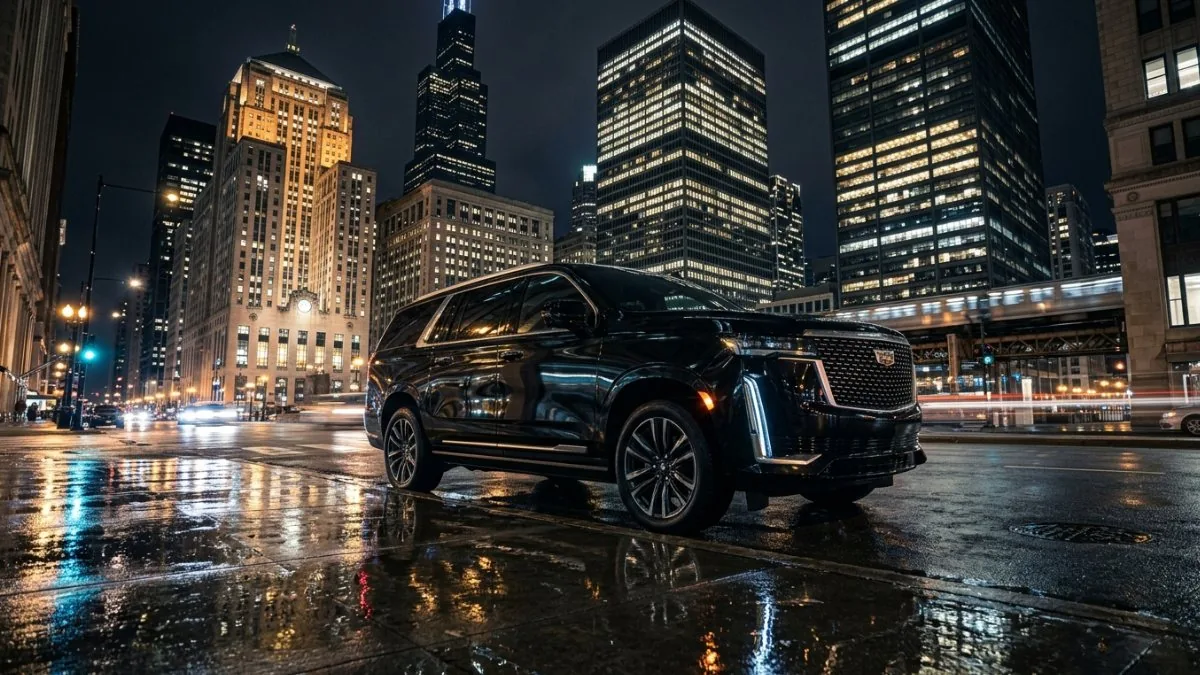
Chicago limo service in winter starts long before the first snowflake. O'Hare averages 38.4 inches of snow a season, and the city sees about 121 days a year when the low drops to freezing or below. Here is how a professional Chicago limo company gets ready, how our SUVs and sedans handle snow, and what you can do to make a winter airport ride easy.
Chicago winter by the numbers
| Fact | Number |
|---|---|
| Normal snowfall at O'Hare, per season | 38.4 inches |
| Snowiest month | January, 11.3 inches on average |
| Days a year with a low of 32°F or colder | About 121 |
| Days a year that stay below freezing all day | About 43 |
| Normal date of the first measurable snow | November 18 |
| Snowiest season on record | 89.7 inches, in 1978-79 |
Source: National Weather Service Chicago, 1991-2020 normals for O'Hare.
How the airport and the roads get ready
Chicago does not shut down for snow, and neither does O'Hare.
- O'Hare's snow team. For the 2019-20 winter, the city put 255 pieces of equipment and about 600 workers on snow removal at O'Hare, from plows to runway brooms.
- One giant de-icing pad. O'Hare's central de-icing facility can treat up to 20 narrow-body planes or 5 wide-body planes at once. Even so, de-icing adds time before takeoff. Read what de-icing means for your flight.
- State highways. IDOT has nearly 1,900 trucks ready to plow about 45,000 lane miles across Illinois.
- The tollways. The Illinois Tollway runs 196 snowplows on its 294 miles of road, including the Tri-State past O'Hare.
How a Chicago limo company prepares for winter
A good winter ride is planned weeks ahead. Here is the checklist a professional Chicago fleet works through before the first big storm.
The vehicles
- Tires checked first. Tread depth and pressure, on every car. Cold air drops tire pressure, and worn tires lose grip fast in slush.
- Batteries tested. Cold mornings are hard on batteries, and a 4 a.m. pickup is no time for a dead one.
- Wipers and washer fluid. Winter blades and fluid that won't freeze, because road salt coats windshields fast.
- Salt washed off. Regular washes keep salt off the paint, the wheels and the underbody.
- Warm and clear before you get in. Snow and ice cleared off the glass and roof, and the cabin warmed up before pickup.
The chauffeurs
- Slow and smooth. IDOT's advice for snow is slower speeds, slower acceleration, slower steering and slower braking. That is exactly how a chauffeur should drive.
- Room to stop. More following distance on the Kennedy and the Tri-State, and extra care on ramps, bridges and shaded spots, where black ice forms first.
- Never crowd a plow. A plow driver may not see you, and the road behind a plow is safer than the road in front of it.
Dispatch
- Forecasts watched days ahead. When snow is coming, pickup times move earlier.
- Every flight tracked. Snow means late arrivals, ground stops and diversions. The pickup follows the real landing time.
- Live traffic, all night. If a road backs up, the chauffeur takes another way.
What we do on snowy days
- Earlier pickups. We add 30 to 45 minutes to pickup times for winter weather, so you still reach the terminal on time. Try our O'Hare leave-time calculator with snow selected.
- Flight tracking and free wait time. If snow delays your flight, your chauffeur waits for your real landing.
- The same flat rate. Your price is set when you book. It does not go up in a snowstorm, and there is never surge pricing.
- Help from curb to car. Your chauffeur loads your bags, and there is an umbrella in every car.
- 24/7 dispatch. A real person answers (708) 998-6634 day and night, storm or not.
More on storm days in our guide to O'Hare pickups in bad Chicago weather.
Which vehicles handle Chicago snow best?
Our fleet is all 2026 and 2027 models. Here is how each one is built for winter, from the makers' specs and published reviews.
| Vehicle | Drive system | Ground clearance | Winter features |
|---|---|---|---|
| Lincoln Navigator | 4x4 standard on 2026 models | 8.9 inches | Slippery and Deep Conditions drive modes, heated front and second-row seats |
| Cadillac Escalade | Rear-wheel drive or 4WD | Not published | Snow/Ice drive mode, Magnetic Ride Control, heated front and second-row seats |
| GMC Yukon XL | Rear-wheel drive or 4WD, with a two-speed transfer case on many trims | 7.3 to 7.8 inches, by trim | Active Response 4WD, heated front seats and steering wheel |
| Chevrolet Suburban | Rear-wheel drive or 4WD, with a two-speed case on the Z71 | Not published | Heated seats, remote start |
| Mercedes-Benz S 580 | 4MATIC all-wheel drive | Sedan height | Rear-axle steering, self-leveling air suspension, heated seats and seat belts |
| Mercedes-Benz Sprinter | AWD offered only on the shorter 12-seat passenger van | Van height | Room for 14 riders and winter bags |
Lincoln Navigator: the most ground clearance
The 2026 Navigator came with 4x4 as standard and sits 8.9 inches off the ground, the most of any vehicle here. Its Slippery and Deep Conditions modes change how the SUV puts power down on snow. It is a strong pick when side streets are not plowed yet.
Cadillac Escalade: a mode made for snow
The Escalade is sold with rear-wheel drive or four-wheel drive. It has a Snow/Ice drive mode that softens the throttle and tightens traction control on slick roads. Magnetic Ride Control reads the road up to 1,000 times a second. On models with GM's two-speed Autotrac transfer case, the AUTO setting is made for wet roads and winter driving.
GMC Yukon XL: room for winter bags
The Yukon XL has the most cargo room of any SUV we run, which matters when everyone packs a winter coat and boots. GMC lists 7.3 to 7.8 inches of ground clearance, depending on trim. Several trims come with a two-speed transfer case that includes a 4 Low gear for deep snow.
Chevrolet Suburban: a proven family hauler
The Suburban shares its build with the Yukon XL. It comes with rear-wheel drive or four-wheel drive, and the Z71 adds a two-speed transfer case. Remote start lets a chauffeur warm the cabin before you get in.
Mercedes-Benz S 580: all-wheel drive, sedan comfort
Every S-Class sold in the US today comes with 4MATIC all-wheel drive. Rear-axle steering helps it turn tight in snowy hotel driveways, and its air suspension levels the car. Mercedes even heats the front seat belts. It sits lower than an SUV, so in deep, unplowed snow we suggest an SUV.
Mercedes-Benz Sprinter: for groups
Mercedes offers AWD only on the shorter 12-seat Sprinter passenger van, so most group vans on the road send power to the rear wheels. In snow, the chauffeur's skill and good tires do most of the work. A Sprinter keeps a group and all its winter bags together in one warm cabin.
Four-wheel drive helps you go, not stop
AWD and 4WD help a heavy SUV pull away from a stop and keep moving in snow. They do not help it stop or turn on ice. Consumer Reports found that all-wheel drive "didn't aid in braking or in certain cornering situations." Stopping comes down to tires and the driver.
- All-season tires stiffen in the cold. Tire makers like Michelin and Nokian say all-season tires lose much of their grip below about 45°F, which is most of a Chicago winter. Winter tires stay soft below that.
- The stopping gap is big. In a Tire Rack test on glare ice, a car on winter tires stopped from 12 mph in 35.1 feet. The same car on all-season tires needed 53.6 feet.
- Luxury cars ship on all-season tires. The Escalade, the Navigator and the S 580 all come from the factory on all-season tires.
That is why a winter-ready company checks tires before anything else, and why a calm, experienced chauffeur matters more than the badge on the car.
Tips for your winter ride to O'Hare
- Leave earlier. Add 30 to 45 minutes on a snowy day. The leave-time calculator does the math.
- Track your flight. Know what "landed" and "at the gate" really mean before you text your chauffeur.
- Pick the right vehicle. More people and bulky winter bags? Use our vehicle size calculator.
- Keep your coat in your carry-on. You will want it at the curb when you land.
- Book before the storm. Set your ride as soon as snow shows up in the forecast. See how far in advance to book.
Frequently asked questions
Do limo and car services run in the snow in Chicago?
Yes. We run 24/7 in every season. On snowy days we pick you up earlier and track your flight, so a storm does not leave you stranded.
Is an SUV better than a sedan in snow?
In deep snow, yes. SUVs sit higher off the ground, and many have four-wheel drive to get moving. A sedan with all-wheel drive, like the S 580, handles plowed roads well.
Which SUV handles snow best?
The 2026 Navigator has the most ground clearance of our SUVs, at 8.9 inches, and came with 4x4 as standard, so it is our first pick for deep, unplowed snow. The Yukon XL has the most room for winter bags.
Does my price go up when it snows?
No. Your flat rate is set when you book, and it includes taxes, fees, tolls and gratuity. There is no surge pricing, day or night.
What happens if snow delays my flight?
We track your flight, so your chauffeur follows your real landing time. Your wait time is free.
Book your winter ride
Snow in the forecast? Book online in a few minutes, or call (708) 998-6634, 24/7. We will set your pickup time with the weather in mind.
Sources
- National Weather Service Chicago: O'Hare climate normals and snow climatology
- National Weather Service: Chicago seasonal snowfall records
- Construction Equipment Guide: O'Hare snow fleet and de-icing pad (2019)
- IDOT winter weather operations and winter driving tips
- IDOT and Illinois Tollway: Winter Weather, Get It Together (2025)
- Lincoln: 2026 Navigator specifications and Drive Chicago: 2026 Navigator review
- Cadillac: Escalade features, GM Authority: 2026 Escalade drive modes and Autotrac transfer case
- GM: Yukon and Yukon XL specifications and GMC: 2026 Yukon AT4
- Chevrolet: Suburban
- Mercedes-Benz USA: S-Class and Sprinter passenger van
- Consumer Reports: Do you really need AWD in the snow?
- Michelin: AWD and winter tire safety and Nokian Tyres: tire buying guide
- Tire Rack: winter vs all-season tires on ice